

Richardson engineered hardwood is a strong fit for slab-foundation homes when you pick a stable core, a real-wood wear layer, and a moisture plan that matches North Texas concrete—not a solid plank that fights the slab.
Many Richardson houses sit on concrete slabs over clay soil. The slab can push vapor up, swing with humidity, and stay cooler underfoot than a wood subfloor. That is why homeowners researching richardson engineered hardwood want dimensional stability without giving up a real hardwood look.
Elegant Floors serves Richardson from the McKinney showroom (and Keller). Call (469) 972-8806. Flooring labor we install includes a 1-year labor warranty.
Service hubs: engineered hardwood · Richardson flooring and remodeling · flooring.
Why slab foundations in Richardson change the flooring choice
Local soil and building patterns make slab-on-grade common across Richardson neighborhoods. A slab is a solid base, but it can transmit moisture vapor—especially after humid stretches or heavy rain. Temperature swings between hot summers and cooler winters also move through the concrete into the first-floor finish.
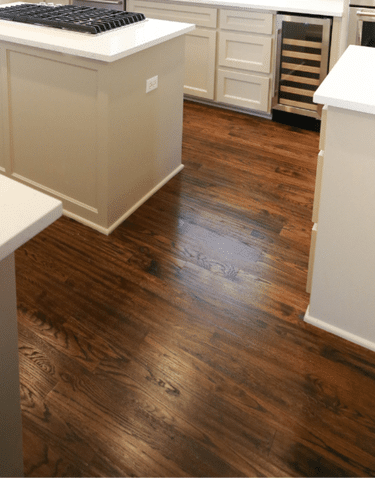
Cross-layered plywood or HDF cores in engineered products resist the cupping and gapping solid hardwood often shows on the same surface. That layered build is the practical reason richardson engineered hardwood shows up in living rooms, hallways, and family spaces over concrete.
Before install day, check flatness, cracks, and moisture. Many manufacturers want readings in a defined range (often expressed as pounds per thousand square feet per twenty-four hours, or an equivalent RH test). Skipping that step is how “good looking” planks fail six months later.
| Floor type | Slab performance | Best use |
|---|---|---|
| Engineered hardwood | More stable than solid on concrete | Main living areas with real-wood look |
| Solid hardwood | More sensitive to slab moisture / movement | Only where conditions and install method allow |
| Waterproof LVP | Highest spill tolerance | Wet rooms / heavy pet zones |
Engineered hardwood vs solid wood on concrete
Solid hardwood absorbs and releases moisture through the full thickness of the board. On a slab that still breathes a little vapor, edges can cup or check. Engineered construction limits movement: the wear layer is real wood, but the cross-grain core holds the shape better when the concrete shifts with the season.
Install method matters too. Many richardson engineered hardwood products float or glue down without nailing into the slab. Solid wood often needs more acclimation and mechanical fastening that can complicate an existing concrete floor. Movement still happens—mostly across plank width—so expansion gaps at walls stay required either way.
If a room sees standing water (laundry, mud entry, kids’ bath), waterproof LVP may be the smarter product for that zone. Real wood belongs where the slab is dry and the lifestyle matches. Compare categories in our engineered hardwood vs LVP guide when you are splitting rooms.
Installation steps that protect richardson engineered hardwood
Successful richardson engineered hardwood jobs start with slab evaluation, not with opening boxes. Pros test moisture at several points, repair cracks, and level within the product’s flatness tolerance (often about 3/16 inch over ten feet). Then they apply primer or a moisture barrier as the manufacturer specifies.
- Verify flatness and moisture before any adhesive or underlayment goes down.
- Acclimate cartons inside the conditioned space for 48–72 hours (follow the product sheet).
- Choose glue-down for a tight bond on level slabs, or a quality floating lock system when slight movement is expected.
- Leave expansion gaps at walls, cabinets, and fixed objects; detail transitions so the slab seal stays intact.
Keep the house at normal living temperature during install. A shut-off AC and a hot garage stash are how planks move after the crew leaves.
Maintenance that keeps slab installs looking even
Daily care is simple: sweep or vacuum grit, wipe spills fast, and damp-mop with a cleaner the finish maker approves. Skip steam mops and standing water—excess moisture at seams can work toward the slab interface over time.
Felt pads under furniture and rugs in traffic lanes cut wear patterns. Periodic professional cleaning can refresh the protective coat without harsh chemicals. Those habits keep richardson engineered hardwood looking consistent through North Texas seasons.
How to choose richardson engineered hardwood for your rooms
Look at wear-layer thickness, core type, and finish durability for each room’s traffic and light. Thicker wear layers allow more refinishing cycles if you need them later. Stable cores handle minor flex across large slab areas. Match grain and color to daylight in the actual house—phone photos lie; Richardson afternoon sun does not.
Bring samples to the North Texas showrooms, or start from the Richardson service area page and the engineered hardwood hub. Pair planks with the right moldings and transitions so the finished run matches the architecture, not just the sample board.
Ready to plan richardson engineered hardwood for your slab-foundation home? Call (469) 972-8806, start a remodel plan, or schedule a free estimate.
FAQ
How does slab moisture affect richardson engineered hardwood over time?
Unmanaged vapor can swell edges or weaken adhesive. Moisture testing, the right barrier, and indoor humidity in a healthy range keep performance steady across seasons.
Can engineered hardwood go directly on an existing Richardson slab?
Yes—after testing, leveling, and the primer or barrier the product requires. Floating or glue-down methods both work when the concrete is ready.
How does care differ from solid hardwood on a slab?
Engineered products usually need less drama around seasonal movement. Focus on surface protection and keeping water out of seams rather than fighting structural cupping.
Does North Texas climate change how richardson engineered hardwood performs?
Humidity and temperature swings can increase vapor drive through the slab. Stable cores and quality finishes handle that better than thin, unstable builds.
What prep steps matter most before install?
Moisture testing, crack repair, leveling if needed, acclimation, and the vapor system the manufacturer specifies. Those steps matter more than the stain color on the sample.
Indoor materials context: EPA indoor air quality.